Suggested slug: `/dog-breeds-hot-weather-risk/`
Meta description: Which dogs struggle most in hot weather? Learn why flat faces, body size, weight, coat and health affect heat risk, and which breeds need extra care.
Which dogs are most at risk in hot weather?
Any dog can overheat.
But the risk is not equal.
Large veterinary studies have found meaningful differences between breeds and body types, with flat-faced dogs, overweight dogs and some large or heavily coated breeds facing particularly high risk. Royal Veterinary College
Why are flat-faced dogs at higher risk?
Dogs primarily cool through panting.
A long, open airway is useful when a dog needs to move large volumes of air quickly.
Brachycephalic dogs have shortened skulls and can have narrowed airways, elongated soft tissues and other anatomical restrictions that make breathing less efficient.
When the dog is hot, the cooling system therefore has to work through an airway that may already be compromised.
Which flat-faced breeds need particular care?
Examples include:
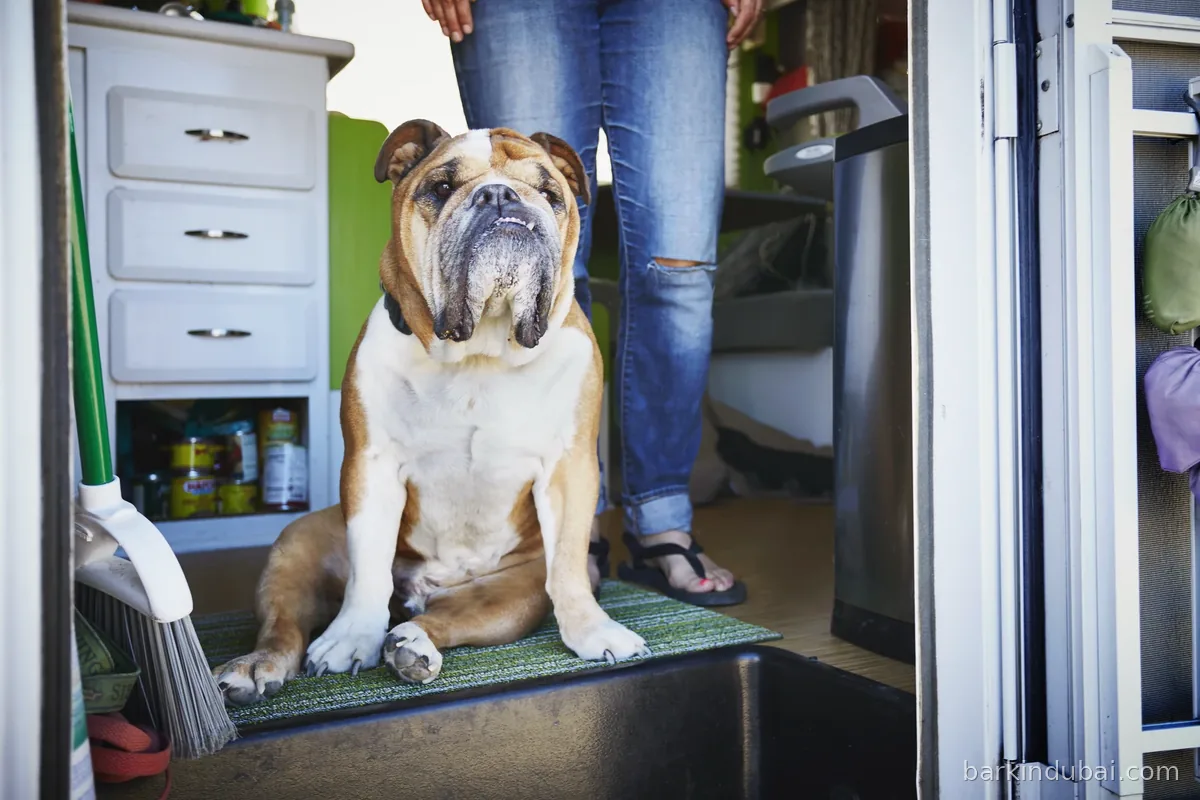
- English Bulldogs
- French Bulldogs
- Pugs
- Boston Terriers
- Boxers
- Dogue de Bordeaux
- some Shih Tzus
- other markedly brachycephalic dogs
RVC research found English Bulldogs had approximately 14 times the heat-related illness risk of Labrador Retrievers in one large study, while French Bulldogs and Pugs were likewise at increased risk. Royal Veterinary College
The exact relative risk is less important to an owner than the message:
These dogs deserve a much more conservative summer routine.
Why are Chow Chows particularly vulnerable?
The Chow Chow combines several characteristics that can make heat management difficult, including body shape and a heavy double coat.
The breed was the highest-risk breed identified in one major RVC analysis. Royal Veterinary College
A Chow Chow living in Dubai should not simply follow the same exercise schedule as a heat-adapted, lean, long-muzzled breed.
Are Huskies safe in hot countries?
A Husky can live in a hot country with responsible environmental management, but a northern double-coated breed should not be expected to behave as though it was designed for Gulf summer exercise.
Air conditioning, careful grooming and highly restricted outdoor activity during hot conditions become especially important.
Do not shave a Husky merely because the weather is hot. Read our separate guide on summer shaving and double coats.
Does a thick coat automatically make a dog unsafe?
No.
Coat is only one factor.
A healthy coat can provide insulation and protection from solar radiation, while a neglected, matted coat can interfere with normal heat exchange.
Recent RVC work nevertheless found double-coated breeds had increased odds of heat-related illness in emergency-care data. RVC infographic
The useful conclusion is not “fur is good” or “fur is bad”.
It is:
Coat type changes heat management and needs to be considered alongside everything else.
Does being overweight increase heat risk?
Yes.
RVC research has identified higher bodyweight relative to breed norms as a risk factor.
An overweight dog carries additional tissue, often has reduced fitness and may have a lower surface-area-to-mass ratio for losing heat efficiently. Royal Veterinary College
In a hot climate, maintaining an appropriate body condition is therefore part of heat safety.
Are older dogs at higher risk?
Older dogs may have:
- reduced fitness
- heart conditions
- respiratory problems
- mobility difficulties
- reduced ability to recover from physiological stress
Age has been identified as a risk factor in veterinary heat-related illness research.
Are puppies at risk?
Yes.
Puppies may be extremely enthusiastic and poor at regulating their own activity.
Do not assume a puppy will stop playing before becoming too hot.
What about Salukis and other desert breeds?
Some breeds have physical characteristics that make heat loss easier, including longer muzzles, lean bodies and lighter coats.
But “heat tolerant” does not mean “heat proof”.
A Saluki can still develop heat-related illness from strenuous exercise, hot surfaces or extreme environmental heat.
How can I estimate my dog's personal heat risk?
Ask five questions.
1. How easily can the dog breathe?
Flat face, airway disease and noisy breathing increase concern.
2. Is the dog lean?
Excess bodyweight increases risk.
3. How old and fit is the dog?
Fitness and general health matter.
4. What type of coat does the dog have?
Heavy coats require additional management.
5. What activity am I asking for?
A calm toilet break and repeated sprinting after a ball are completely different heat loads.
The most important point
Breed influences risk.
It does not determine destiny.
A supposedly heat-tolerant dog can overheat through poor management, while a high-risk breed can have a good quality of life in Dubai with careful environmental control.
The correct summer plan should be built around the individual dog.
Start with the pillar guide: how hot is too hot to walk a dog?
Sources and evidence
Every factual claim above is drawn from the following published sources.
This guide is for general information and is not a substitute for veterinary advice. If you are worried about your dog in the heat, contact your vet.